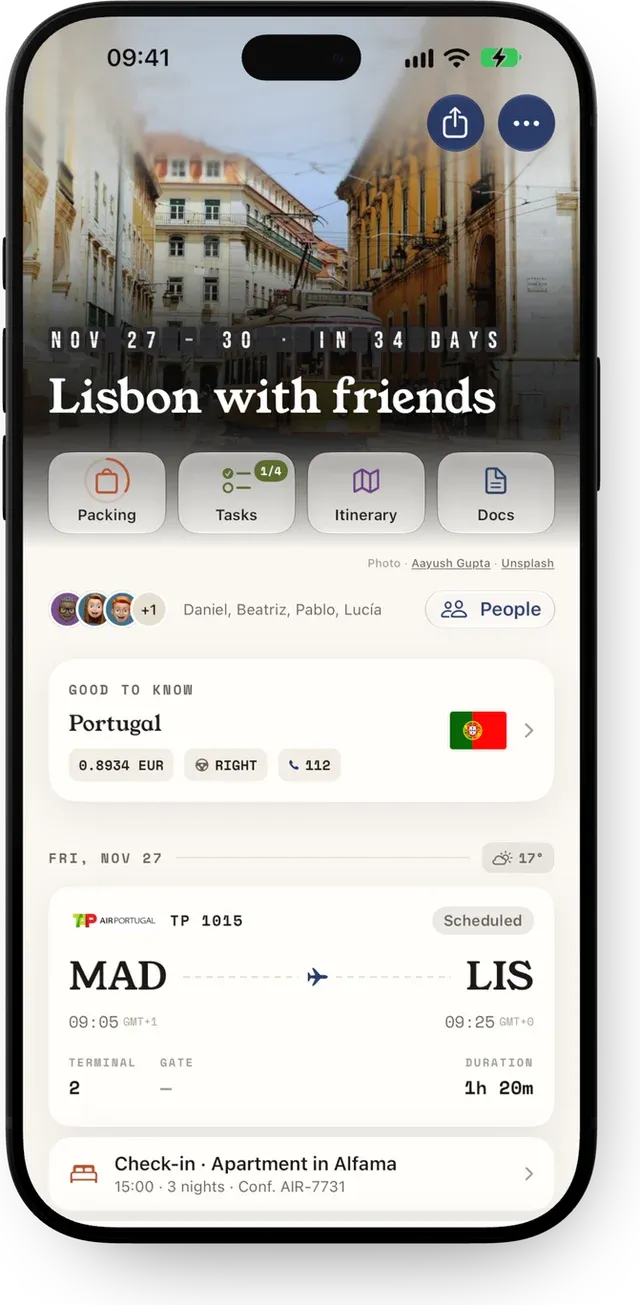
Planning a trip with friends comes down to a few decisions made early: when you go, how much you spend, and who books what. Settle those before anyone pays for anything, keep the plan in one place you can all see, and the trip itself is the easy part.
The example here is a long weekend in Lisbon for four friends (Daniel, Beatriz, Pablo, and Lucía), planned from start to finish in Traypass.
Agree on three things before anyone books
Dates, budget, and the kind of trip come first, because every booking depends on them. Ask for them early and set a day to decide, or the group chat goes quiet and nobody books.
- Dates: offer two or three options and let everyone say which ones work. Go with the one that suits the most people.
- Budget: put a number on it (“about €400 each, flights included”), not “something cheap.” It’s easier to say up front than to argue about later.
- The kind of trip: city walks, beach, hiking, nights out. A weekend built around one person’s idea of a vacation rarely suits anyone else.
Then pick somewhere everyone can reach without a long, expensive connection. Lisbon works for four friends in Madrid: an 80-minute flight and a city you can see on foot.
 Paulo Evangelista · Unsplash
One shared plan, not the group chat
Keep the trip in one place everyone can open and change. A group chat is good for talking and bad for finding things: the flight times are 300 messages up, and nobody knows if the apartment is booked.
- People on one trip
- 20
- The most a Traypass trip can hold
- Invite link
- 7 days
- How long the link works; there's a QR code too
- For the friends you invite
- Free
- Joining a trip costs nothing
Invite everyone to the same trip
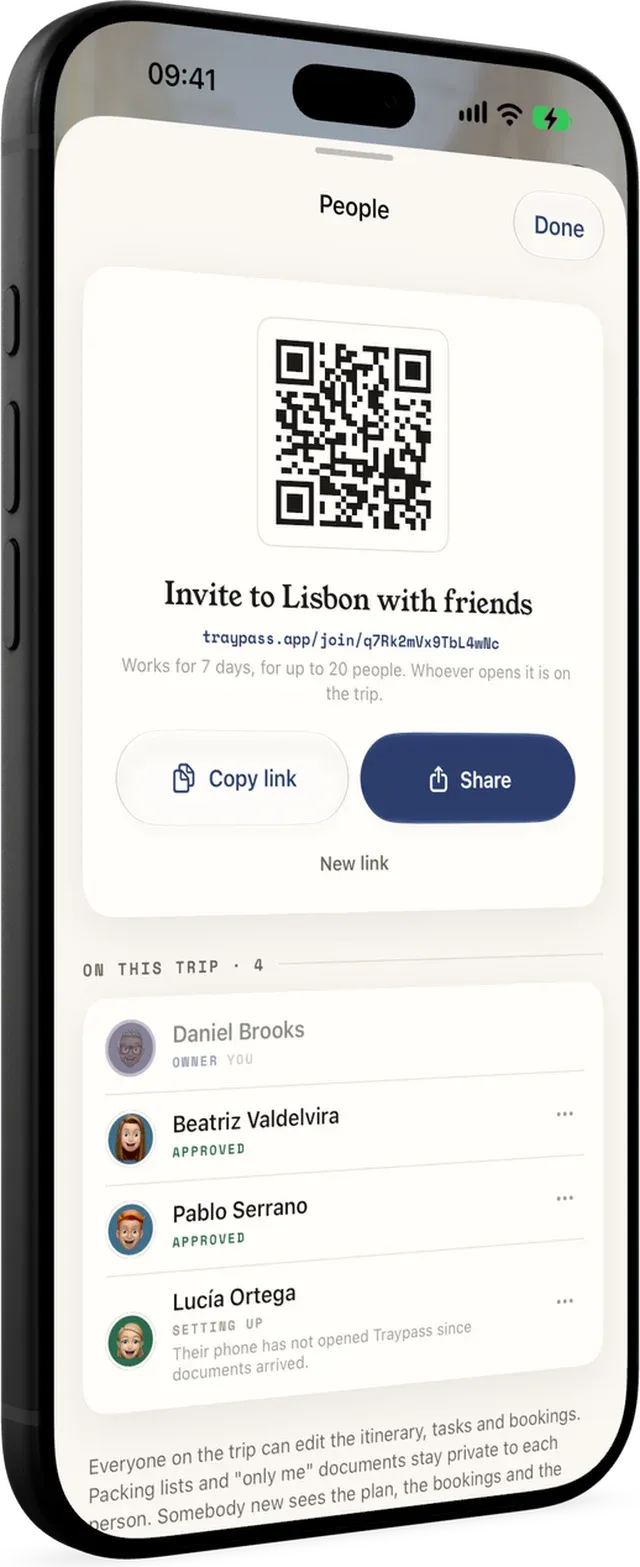
In Traypass, one person creates the trip and shares a link, or shows the QR code. The link works for 7 days, for up to 20 people. Here, Beatriz and Pablo are in, and Lucía hasn’t finished setting up yet.
Everyone on the trip can edit the itinerary, the tasks, and the bookings. Each person’s own packing list stays private, and so do documents saved as “only me.”
Give every booking one owner
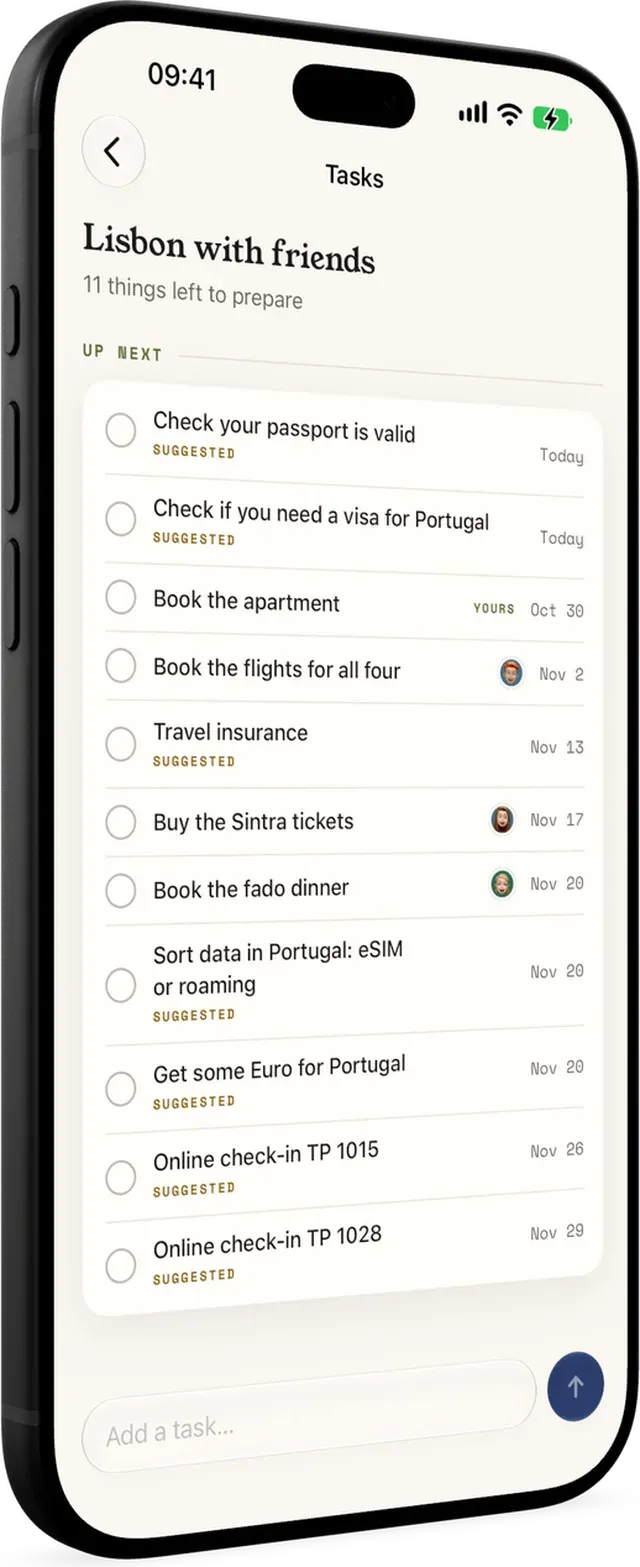
The trip goes better when each booking has one name and one date on it. Daniel books the apartment by October 30, Pablo the flights for all four by November 2, Beatriz the Sintra tickets, and Lucía the fado dinner.
Everyone sees what is done and what isn’t, and nothing gets booked twice. Traypass suggests the tasks most trips need, like travel insurance, euros for Portugal, and online check-in the day before the flight.
Decide who brings what
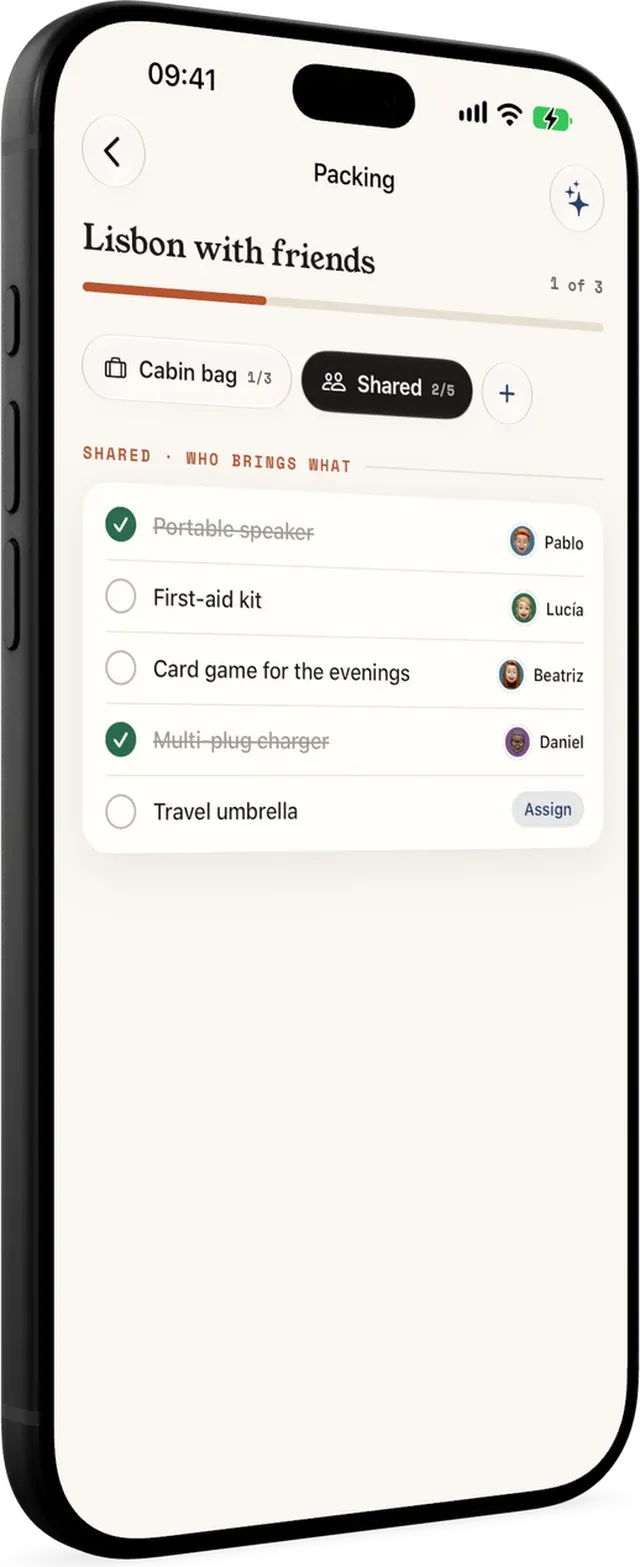
A shared list stops four people from packing four speakers and no first-aid kit. Put one name on each thing: Pablo brings the speaker, Lucía the first-aid kit, Beatriz a card game for the evenings, Daniel a charger with several plugs.
Anything without a name still needs someone to bring it, like the umbrella here.
Plan the days, and leave some free
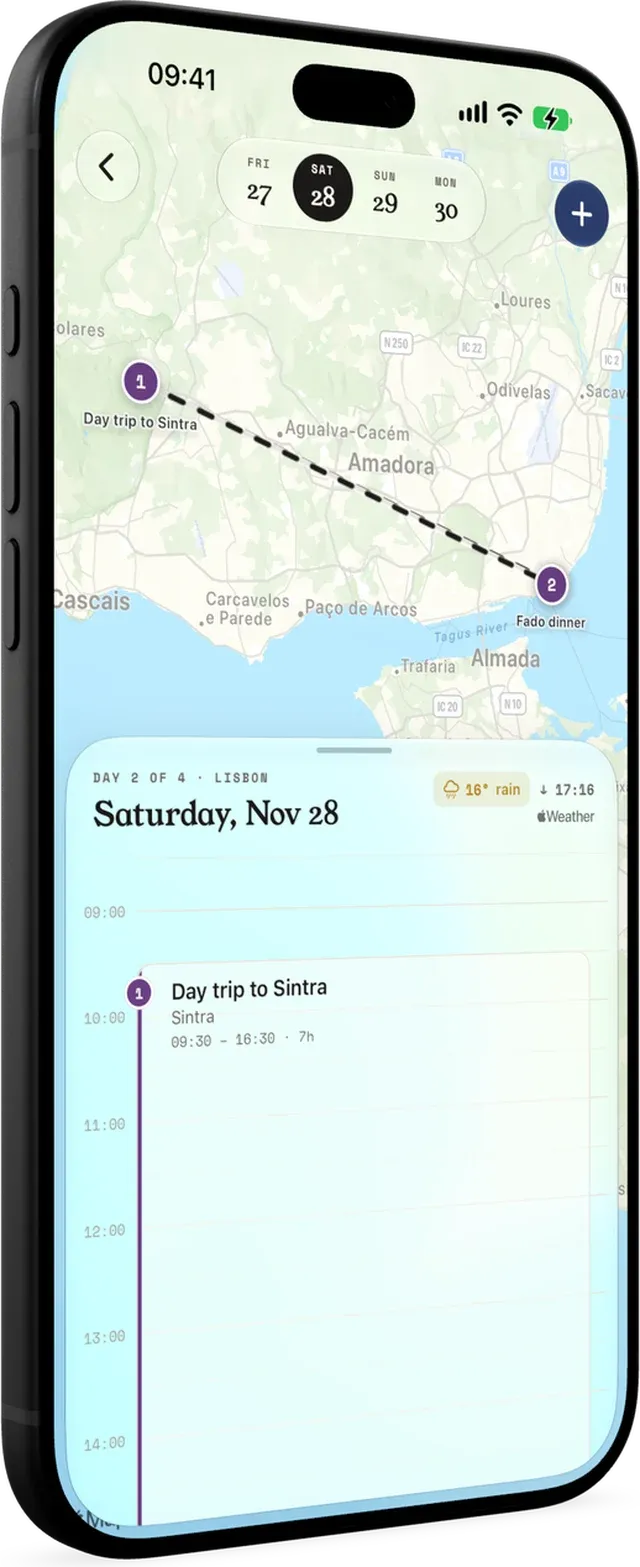
Put the fixed things in the plan, with their times: Saturday is the day trip to Sintra, from 9:30 a.m. to 4:30 p.m., then the fado dinner. Everyone sees the same day on their phone, with the weather and when the sun sets.
Then leave gaps. Sunday morning in Belém, Sunday afternoon free: some go back to the apartment, some keep walking, and everyone meets for dinner.
Don’t leave what sells out to the last minute
Book anything with a fixed time slot once you know which day you’ll go, not in the last few days before the trip. Those slots fill up first, and a group needs several spots at the same time.
 Dmitry Voronov · Unsplash
Pena Palace in Sintra lets you in only on the day and at the time on your ticket. If you arrive after your slot, you can’t go in and the ticket isn’t refunded. The train from Rossio station in Lisbon takes about 40 minutes, and the palace sits on a hill above the town, so book a slot at least an hour after your train gets in.
The same goes for a dinner for four on a Saturday night, or any show you all want to see. One person books it, and everyone sees that it’s done.
Split the costs without falling out
Agree on how you’ll split the money before the first payment. It is much easier at the start than after the last dinner.
- Decide the rule: split shared things (the apartment, the taxis) evenly and let each person pay their own flights, or split everything.
- One person pays for each booking, and the others pay them back within a few days, not at the end of the trip.
- Write down every shared cost, with who paid and how much, in an expense app or a shared note.
- A kitty for small things: everyone puts in the same amount for coffee, pastries, and tickets, and you refill it when it runs low.
 Eilis Garvey · Unsplash
Traypass keeps the plan and who is booking what; it doesn’t split the costs. Pick one expense app at the start and put every shared cost in it.
Keep the peace on the trip
Most arguments on a trip with friends are about money, pace, or rooms, and all three are easier to settle before you go.
- Rooms: decide who sleeps where when you book, not at the door.
- Pace: early risers and late sleepers can split up for a morning and meet for lunch.
- One person decides each day: take turns choosing where to eat, so the group doesn’t stand on the sidewalk for 20 minutes.
- Time apart is fine: a free afternoon keeps a long weekend from feeling too long.
 João Reguengos · Unsplash
A timeline for planning a trip with friends
For a long weekend, about two months is enough. In the Lisbon example, the apartment and the flights are booked four weeks ahead, and the tickets and the dinner in the last two.
| When | What | Who |
|---|---|---|
| 8 weeks before | Dates, budget, and the kind of trip | Everyone |
| 6 weeks before | Create the trip and invite everyone | One person |
| 4 weeks before | The place to stay and the flights | One owner each |
| 2 weeks before | Tickets with time slots and dinner reservations | One owner each |
| 1 week before | Who brings what; the plan for each day | Everyone |
| The day before | Online check-in and the first day’s plan | Each person |
The group trip planner in Traypass keeps all of it in one trip: the people, the bookings and who makes them, the shared list, and the plan for each day.
 TraypassApp Store